The floor feels cool against your arms. Your toes push down on the mat, and your legs work hard. Your breathing becomes more regular. With your stomach tense and your mind focused, a question comes to mind: “How long should I stay in this position?” Ten seconds? Thirty seconds? Two minutes that seem to last forever? People think that planks are a simple exercise that works the same for everyone, but they are really a relationship between your body and gravity that changes as you get older. At 18, what feels strong and easy is a different kind of challenge at 48 or needs more care at 68. Your core is always the most important part of your body. It is the hidden structure that keeps your spine stable and protects your back while you move around. So, how long should you hold a plank to get the best results for your core without pushing yourself too hard or letting your pride get in the way? To find out, you need to know exactly how your body is right now.
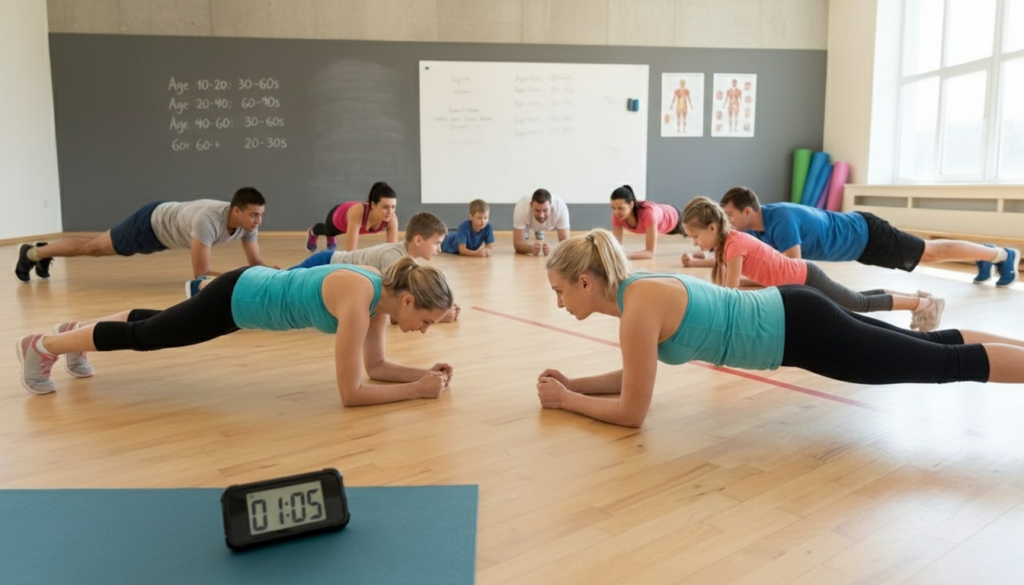
How to Time a Plank Hold
Planks are not the same. They come in quietly. You line your body up in a long line, with your shoulders stacked over your elbows or wrists, your heels reaching back and your head floating easily between them. Nothing seems to be moving. It looks like it doesn’t take much effort from the outside. But inside, a quiet storm is brewing. The transverse abdominis cinches your midsection like a supportive belt, the multifidus protects your spine in a subtle way, the diaphragm connects breath to effort, and the pelvic floor gives you steady support from below. These muscles don’t like intensity or drama. They work best when you do the same calm, precise thing over and over again.
The Quiet Storm Inside You
That’s why “how well” and “how often” are much more important than “how long.” A tense, collapsing one-minute plank does less good and is more dangerous than a clean twenty-second hold where your body feels strong, aligned, and calm. Time is still important, but it should match the moment your form starts to fade, not go past it.
The 2-Minute Plank Myth
For a long time, fitness culture has praised extremes. Planks for two minutes. Five-minute tests. Clips of bodies shaking and holding on with sheer willpower. At some point, longer became the same as better. The less flashy truth is that extending a plank builds tolerance for discomfort more than it builds useful strength after a certain point. Research and experienced coaches tend to agree that doing short, high-quality holds multiple times is better for core strength and spinal health than doing long, hard workouts every once in a while.
The Plank Equation, Age, and Gravity
The body’s calculations change over time. The recovery process slows down a little bit. Tissues are less forgiving. You need to pay more attention to balance and coordination. A plank that used to be easy may now feel more like work. This isn’t a sign of weakness; it’s just how biology works. It’s better to think in flexible ranges than to follow one strict rule. The goal is to hold on for as long as it takes for your form to start to fall apart.
Age Range and Suggested Hold Time
Age Range Suggested Hold Time (for each set) Sets Weekly Frequency
| Age | Suggested Hold Time | Sets | Weekly Frequency |
|---|---|---|---|
| Teens (13-19) | 20-40 seconds | 2-4 | 2-4 days |
| 20s-30s | 30-60 seconds | 2-4 | 2-4 days |
| 40s | 20-45 seconds | 2-4 | 2-4 days |
| 50s | 15-40 seconds | 2-3 | 2-3 days |
| 60s-70s+ | 10-30 seconds | 2-3 | 2-4 days |